



Thursday, January 27, 2011


Tuesday, January 4, 2011
Letter to the Bank #60
 |
| Thomas Gilray |
dear BM,
As we start not only a new year but a new decade I think again about the motivations I have to write these letters to you my imagined financial advisor and therapist, the target of my ire and my confident. You are asked to fill a difficult role. You are my punching bag and sounding board.
I am a bird in your ear, and your rear, twittering away and clearly, with so much to say I should be Tweeting to. I’m just a little shy of the medium for no reason I can find. The quiet persistence of blogging with the high probability that nobody reads what I write is almost comforting. I do and I don’t want to effect the Conversation. I’m slightly mistrusting of my own motivations, and not sure of my wit or candor. By Tweeting I’d be going out on a limb. I’ll have to be pithy and precise. I like messy but few have time for that. My long winded, old fashioned letters will be converted to haikus in the near future. I’ll miss wordy. In the world of art the word baroque conjures up images of too much gold and too much in general. That said I love dense passages in books and rich images, symmetry and patterns that are taken to the nth degree. I’m just not happy with ostentatious. Shakespeare is rich and even over the top but he delights in language and has something to say. What would he have done with twitter?
On another matter I do hold the responsibility for the words I utter though often uttered under a fragile pseudonym. The pseudonym acts as a character in my plays not a front to hide behind. I believe in being open when expressing one’s opinions. This is a luxury we still have in the USA that is still sorely lacking in so many other societies. To not be up front in this country with one views strikes me as cowardly. I will not read anonymous articles or thoughts by others if they cannot be sourced back easily. This quote from Stanley Fish’s article in NYT Opinions page today (1/4/11) puts it well:
The practice of withholding the identity of the speaker is strategic, and one purpose of the strategy (this is the second problem with anonymity) is to avoid responsibility and accountability for what one is saying. Anonymity, Martha Nussbaum, a professor of law and philosophy at the University of Chicago observes, allows Internet bloggers “to create for themselves a shame-free zone in which they can inflict shame on others.” The power of the bloggers, she continues, “depends on their ability to insulate their Internet selves from responsibility in the real world, while ensuring real-world consequences” for those they injure.
My blogs feel powerless and that is okay. I’m interested in civil discourse. Anger is effective when expressed with clarity. If you shout at me I’ll cover my ears after trying briefly to tease out what it is you might be trying to say. Draw me in don’t shut me out and let me see you as we converse. You meanwhile remain silent never responding like a Freudian analyst. I always preferred the idea of Jungian therapy where there is some give and take. Do you agree with my musings on greed, my postings about the filthy rich and the dirt poor? Are you in the middle—slightly mad at your superiors, your bosses, though disinclined to blow a whistle or stick your head up above the trenches incase it gets blown off?
Remember I am always happy to talk about art. If you do not want me to discuss the awful underpinnings of this ownership society then let us talk about Art and I don’t mean blue chip art, or popular art, or even satire. Tell me about a painting or a play or a poem that stuck with you and try to tell me why.
Yours sincerely,
Kristian Witherkay
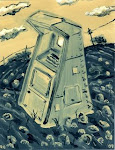
PS—Don't take my image choice too personally.
Sunday, December 19, 2010
Letter to the Bank #59

I’ve been reading so many op-eds, editorials, books, columns about the worldwide financial crisis that I’ve hardly had time to pen my own artsy and numerically illiterate response to the crisis. You could well argue, given the volume of words on the subject one does not need me to add to the pile but humans need to vent as is clear from the millions of bloggers and twitterers out there. I’m just one of them.
What gives my letters to you, my essays (as defined by Montaigne an essay is a melding of the intellectual and the personal) their particularity is the angle I offer of an artist obsessed by greed and its sad counterpoint poverty. In a world that could feed itself if only it could agree to do so it makes me mad to see individuals piling up obscene amounts of personal wealth given the desperation out there. I also cannot stop opining on why some choose the pursuit of creativity and others choose to create money. This fascinates me I suppose and the difference between the two is not always obvious. There are people in the world of finance who seek to create wealth and end up trying to eradicate malaria, and there are artists who decide to make things and discover a way to make objects that is tantamount to printing their own money—quantitative-easing-explainedquantitative easing if you like.
I met a real banker last night. I was not seeking a loan to fix my leaking roof. I was at a party making conversation! I was holding a glass of—well in my case water because I was still coping with a hangover from my spouse’s office party the night before—but it could as well have been fine wine because fine wine is a specialty at our good friends’ Jane and Debras’ Christmas Party. The gentleman I was speaking to said he worked for the Bank of Scotland and in my scattered readings I’d gathered this was one, big struggling institution so I deigned to ask about its’ troubles. He was forthright saying like many banks an act of hubris had lead to its’ current precarious state. I added my interest was that of a mere dabbler in the dark arts of finance and that I described myself with regularity as numerically dyslexic. He said that really a bank is just a big version of what everybody is dealing with when it comes to their own personal finances. Some handle those finances well and some don’t. This struck me as a nice conciliatory note with which to end my last letter of the year. He was a nice man and struck me as, at the very least as honest as I attempt to be. The only difference was that he handles a substance of nuclear proportions and my medium is, when it remains distinctive from the Bureau of Engraving and Printing and the United States Mint, much like sand—loved and much trodden upon.
I do want to add one more little story. Planet Money did a piece the other day about the little island of Yap, Micronesia, where money or currency took/takes the form of huge limestone disks called rai, disks described as stunningly beautiful when radiant and white in the sunshine. This is a great example of what I’ve been trying to say all along—Art is definitely worth more than money. Art is what people should be exchanging for the things they need. If instead of being passed on like regular currency it is kept and enjoyed all to the good! People just have to make more money—I mean Art—and it wouldn’t be considered illegal.
Yours sincerely,
Kristian Witherkay
Friday, November 19, 2010

Unemployed Angel
 |
| Simpkins from Accounting. Laid off last year and only three weeks of unemployment left. He just cannot find work. Nobody needs honest budgeting officers. |
Wednesday, November 17, 2010
Art & finance: the latest from the barricades

Tuesday, November 16, 2010
Letter to the Bank #58
Dear Financial Engineer,
We do not expect this to make sense, or for you to understand as I—no fan of banks—do shower down upon you a hail of incomprehensible ponderings on the subjects of money and art, art and poverty, wealth and acquisition, greed and patronage of the arts. As one of your clients I do expect you to sit there squirming, suffering through my abstract tirades, my obscure assaults on your wrong headed approach to life, the Universe and everything. Clearly those whose lifetime pursuit of money finds them sitting pretty must feel that their chosen path is somewhat justified. They have all the stuff of their dreams and can only hope to acquire the one last item on their list—intelligence, or something that approximates depth. Perhaps there is an outrageously expensive machine that can inject the sum of everything into the brain, a time saving educational device that in much the same way money saving devices like collateralised debt bundles need no further input once turned on to churn out profit, will provide infinite wisdom whilst requiring no book learning or essay writing, no work in fact.
You might detect a hint of frustration in my writing. As an artist I have no interest in trying to grasp the intricacies of your grasping ways and am determined to maintain my oblique tangent on life but I do resent the way once you have money you can with little thought churn out more and more of the stuff. My approach to trying to get through to you is patently absurd and that is the way I like it! I am baffled by what you do and hope you are equally baffled and shut out by the meager but honest meanderings of a creative mind such as my own. The frustration you detect is based on the fact that I would also like to have a money machine at my bedside that required no input from me as it churned out a living, enough at least to keep our family at some distance from fear of starvation. I'm not interested in the pursuit of money. It bores me. You see I can think of a million things to do with my time. I'd make art. I'd be ever fascinated by the effort to contribute to the big essay of life. I wouldn't find taking and taking and taking that satisfactory. I only want enough money to fend off constant worry. I understand that is a highly mutable amount but do believe if I were confident I could secure enough to support our basic needs we'd be inclined to send the extra toward the helping of others. My most basic need is peace of mind. If only we could secure peace of mind for everyone. So much human capitol is wasted on worry. Freed of anxiety humans would produce so much more effectively be it in the arts or indeed in industry where a happy employee would surely be happy to work if they were confident that they and theirs could rest secure in the belief they'd be provided for. That may be the kernel of this letter, the core of this thesis.
Your response to this:
1.—Hmmmm! Perhaps we should spread the wealth? Perhaps having the wealth concentrated in the hands of a tiny minority is wrong!
2.—Hmmm! Clearly we are dealing with a liberal/populist/socialist/communist/atheist and anti-plutocrat! Ah! His address is on the envelope!
Yours sincerely,
 Kristian Stillwitherkay
We do not expect this to make sense, or for you to understand as I—no fan of banks—do shower down upon you a hail of incomprehensible ponderings on the subjects of money and art, art and poverty, wealth and acquisition, greed and patronage of the arts. As one of your clients I do expect you to sit there squirming, suffering through my abstract tirades, my obscure assaults on your wrong headed approach to life, the Universe and everything. Clearly those whose lifetime pursuit of money finds them sitting pretty must feel that their chosen path is somewhat justified. They have all the stuff of their dreams and can only hope to acquire the one last item on their list—intelligence, or something that approximates depth. Perhaps there is an outrageously expensive machine that can inject the sum of everything into the brain, a time saving educational device that in much the same way money saving devices like collateralised debt bundles need no further input once turned on to churn out profit, will provide infinite wisdom whilst requiring no book learning or essay writing, no work in fact.
You might detect a hint of frustration in my writing. As an artist I have no interest in trying to grasp the intricacies of your grasping ways and am determined to maintain my oblique tangent on life but I do resent the way once you have money you can with little thought churn out more and more of the stuff. My approach to trying to get through to you is patently absurd and that is the way I like it! I am baffled by what you do and hope you are equally baffled and shut out by the meager but honest meanderings of a creative mind such as my own. The frustration you detect is based on the fact that I would also like to have a money machine at my bedside that required no input from me as it churned out a living, enough at least to keep our family at some distance from fear of starvation. I'm not interested in the pursuit of money. It bores me. You see I can think of a million things to do with my time. I'd make art. I'd be ever fascinated by the effort to contribute to the big essay of life. I wouldn't find taking and taking and taking that satisfactory. I only want enough money to fend off constant worry. I understand that is a highly mutable amount but do believe if I were confident I could secure enough to support our basic needs we'd be inclined to send the extra toward the helping of others. My most basic need is peace of mind. If only we could secure peace of mind for everyone. So much human capitol is wasted on worry. Freed of anxiety humans would produce so much more effectively be it in the arts or indeed in industry where a happy employee would surely be happy to work if they were confident that they and theirs could rest secure in the belief they'd be provided for. That may be the kernel of this letter, the core of this thesis.
Your response to this:
1.—Hmmmm! Perhaps we should spread the wealth? Perhaps having the wealth concentrated in the hands of a tiny minority is wrong!
2.—Hmmm! Clearly we are dealing with a liberal/populist/socialist/communist/atheist and anti-plutocrat! Ah! His address is on the envelope!
Yours sincerely,

Subscribe to:
Posts (Atom)


